Pythagorean Theorem

This man, is Pythagoras. He was one of the first Greek Mathematicians. He discovered an amazing property of the right triangle that we all now know and love as the Pythagorean Theorem.
This theorem is well known in Algebra and we study it in our Quadratics unit because we are working with squared terms. Take a look.
The Pythagorean Theorem
In any right triangle, the sum of the squares of the legs (2 shorter sides) is equal to the square of the hypotenuse (the longest side).
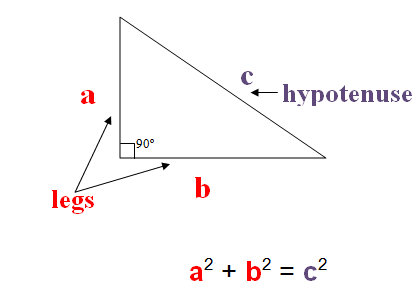
Please Note: This theorem ONLY works for Right Triangles.
Let's start by taking a look at an example where we need to find the hypotenuse.
Pythagorean Theorem - Example 1
In a right triangle, the length of one leg is 6 cm and the length of the other leg is the square root of 13 cm. Find the length of the hypotenuse.

Now let's look at an example of a problem where we are asked to find the length of a leg of a right triangle.
Pythagorean Theorem - Example 2
A ladder that is 16.5 feet tall is placed against the side of a tree. The base of the tree to the top of the ladder is a distance of 14 feet. How far is the ladder placed away from the base of the tree?
If word problems confuse you, the best thing you can do is draw a picture!
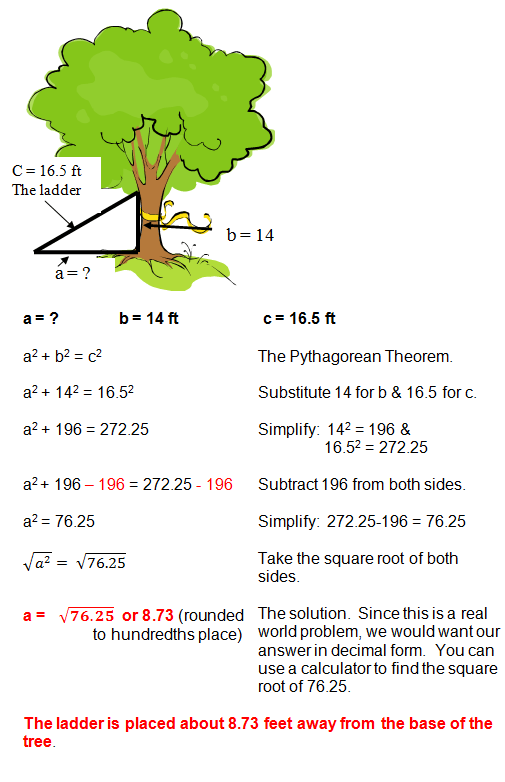
Let's take a look at one more example!
Pythagorean Theorem - Example 3
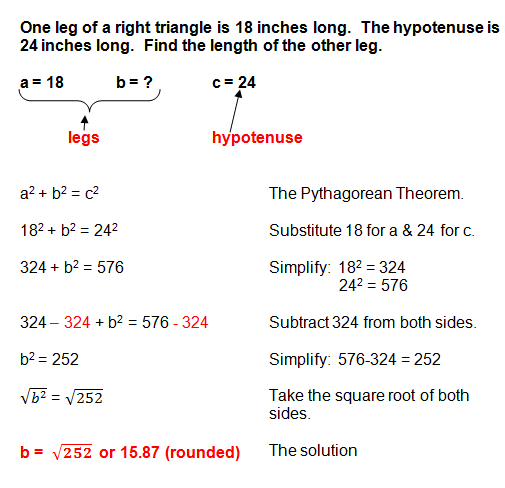
Great Job! Now you are ready to continue your exploration of quadratic equations.

Need More Help With Your Algebra Studies?
Get access to hundreds of video examples and practice problems with your subscription!
Click here for more information on our affordable subscription options.
Not ready to subscribe? Register for our FREE Pre-Algebra Refresher course.







Need Help? Try This Online Calculator!
Affiliate Products...
On this site, I recommend only one product that I use and love and that is Mathway If you make a purchase on this site, I may receive a small commission at no cost to you.
Comments
We would love to hear what you have to say about this page!